Flashlight Physics · June 2026 Physics Regents cluster
From NY Science Standards Wiki
| ← Cluster 6 of 10 | ⇱ June 2026 Physics Regents Exam | Cluster 8 of 10 → |
Flashlight Physics is cluster 7 of 10 on the June 2026 Regents Examination in Physical Science: Physics (questions 30–35). Each question is shown with its answer key and the performance expectation it assesses.
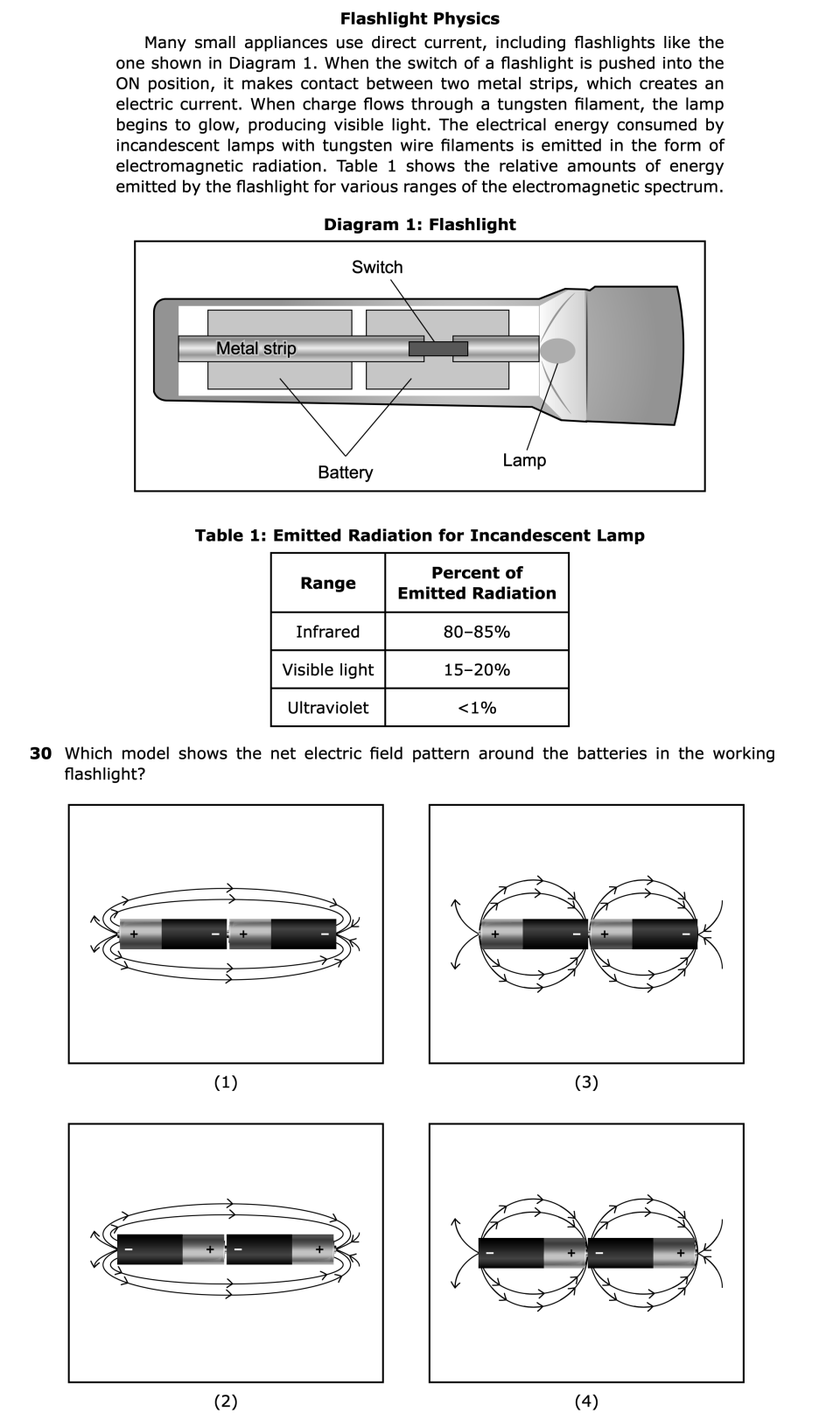
Question 30 · HS-PS2-4
PLD · Level 1HS-PS2-4 · Gravitational and Electrostatic Forces
Level 1Given data, information, or a model, draw or identify the direction, with or without the magnitude, of the the gravitational force(s) or field, or electrostatic force(s) or field, or determine the magnitude of the gravitational force(s) or field, or electrostatic force(s) or field.

Question 31 · HS-PS4-1 EM Spectrum v = fλ
PLD · Level 1HS-PS4-1 · Wave Properties
Level 1Draw a model of a wave with given characteristics or identify the characteristics of a given wave traveling and transferring energy in a medium (period, frequency, wavelength, amplitude, speed, and/or type), or identify the change in characteristics of a wave as the wave hits a boundary.


HS-PS3-6 · Ohm's Law and Circuits
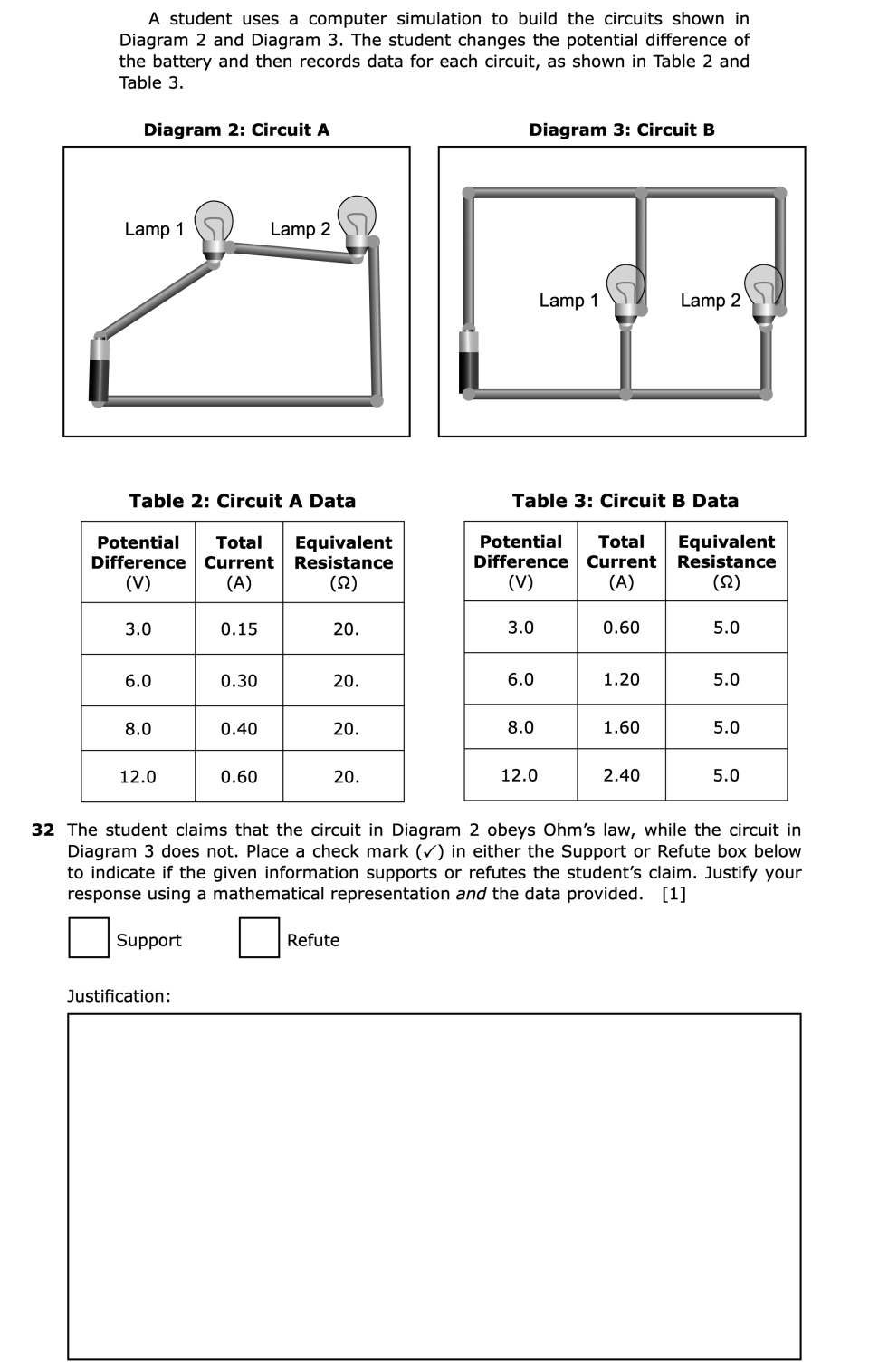
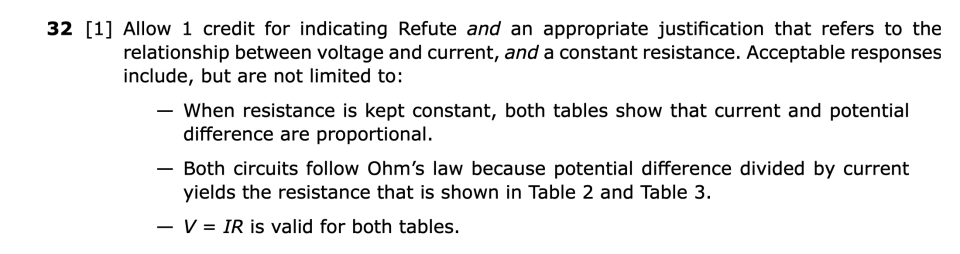
Level 4Analyze data to support the claim that Ohm’s Law describes the mathematical relationship among the potential difference, current, and resistance of an electric circuit.
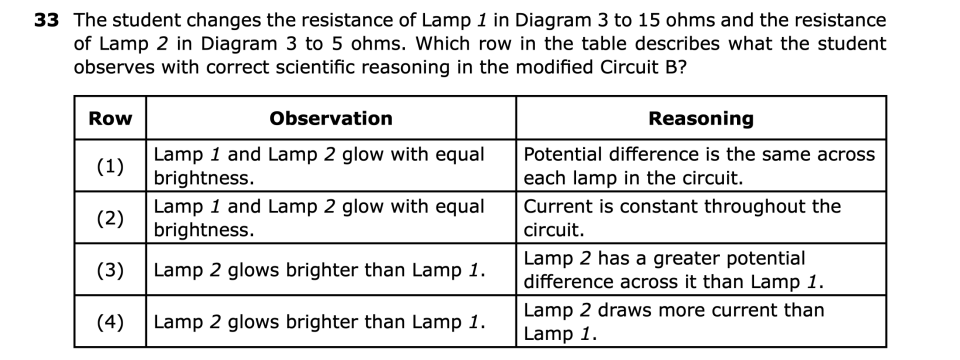
Question 33 · HS-PS3-6 V = V1 = V2 = … V = IR
PLD · Level 2HS-PS3-6 · Ohm's Law and Circuits
Level 2Given a schematic diagram, description of, and/or data for a circuit (simple, series, or parallel), identify a pattern among the potential difference, current, resistance, power, or energy of the circuit or an individual circuit component, or apply a pattern to determine the potential difference, current, resistance, power, or energy of the circuit or an individual circuit component.

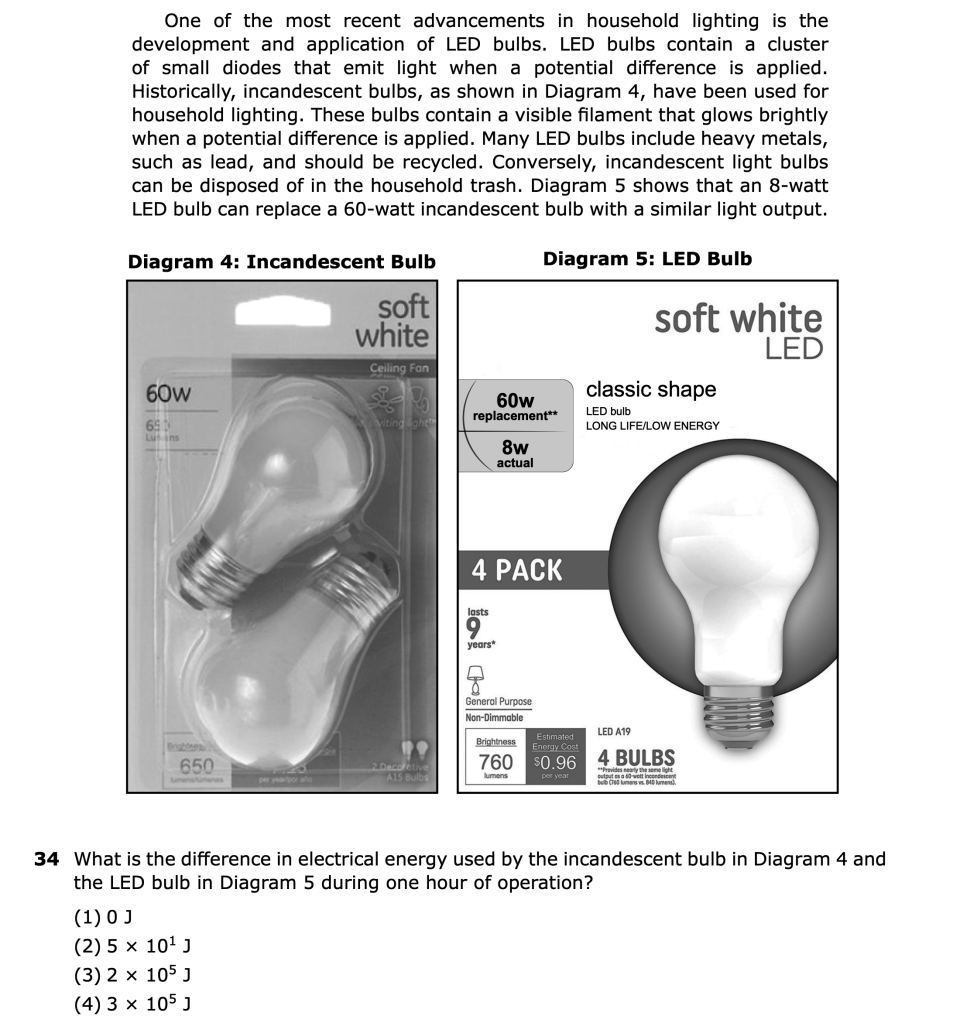
Question 34 · HS-PS3-6 W = Pt = VIt
PLD · Level 1HS-PS3-6 · Ohm's Law and Circuits
Level 1Given a description and/or schematic diagram of a circuit, identify the direction of the conventional current in the circuit, or given a description and/or data of a circuit, identify the corresponding schematic diagram for the circuit, or given a description of, schematic diagram of, and/or data for a series or parallel circuit, use evidence to support the identification of the circuit, or given a schematic diagram, description of information about, and/or data for a simple circuit, determine the potential difference, current, resistance, power, or energy of the circuit.