Difference between revisions of "HS-PS1-11"
(Rewrite Phenomena section: photo gallery plus one entry per phenomenon used in released Regents questions, each linked to its question) |
(PLDs: add example released question for Levels 1–3 (editor judgment; no released question yet matches Levels 4–5)) |
||
| Line 115: | Line 115: | ||
| Level4 = Plan and conduct an investigation to compare properties and behaviors of acids and bases. | | Level4 = Plan and conduct an investigation to compare properties and behaviors of acids and bases. | ||
| Level3 = Given a plan, conduct an investigation '''<u>or</u>''' given the results of an investigation or provided information, compare the properties and/or behaviors of acids and/or bases. | | Level3 = Given a plan, conduct an investigation '''<u>or</u>''' given the results of an investigation or provided information, compare the properties and/or behaviors of acids and/or bases. | ||
| + | | Example3 = [[Questions:Photosynthetic Pathways#q3|June 2026 Question 40]] | ||
| Level2 = Given the results of an investigation or provided information, calculate a quantity or make a claim to identify a property and/or behavior of an acid or base. | | Level2 = Given the results of an investigation or provided information, calculate a quantity or make a claim to identify a property and/or behavior of an acid or base. | ||
| + | | Example2 = [[Questions:Pool Water Chemistry#q2|August 2026 Question 23]] | ||
| Level1 = Given an investigation plan or provided information, select appropriate tools and/or materials that could be used to identify a property or behavior of an acid or base. | | Level1 = Given an investigation plan or provided information, select appropriate tools and/or materials that could be used to identify a property or behavior of an acid or base. | ||
| + | | Example1 = [[Questions:Chemistry of Beverages#q5|June 2026 Question 10]] | ||
}} | }} | ||
Revision as of 01:46, 16 October 2026
Plan and conduct an investigation to compare properties and behaviors of acids and bases.
Clarification statement: Examples of properties could include pH values (concentration), neutralization capability and conductivity. Observations of behaviors could include the effects on indicators, reactions with other substances, and efficacy in performing titrations.
Assessment boundary: Reactions are limited to Arrhenius and Bronsted-Lowry acid-base reactions.
Note: this is a NYSED-specific performance expectation that is different from the Next Generation Science Standards.
Regents Exam Questions
Released New York State Regents exam questions that assess HS-PS1-11 are listed here by exam and question cluster. Each link opens the question with its answer key.
Vocabulary
Terms from the Chemistry Glossary that come from this standard or from the released exam questions that assess it.
- accuracy
- acid
- acid rain
- acid-base reaction
- Arrhenius acid-base reaction
- base
- Bronsted-Lowry acid-base reaction
- chemical reaction
- claim
- concentration
- conductivity
- evidence
- indicator
- investigation
- neutralization
- neutralization capability
- pH
- phenomenon
- precision
- properties
- reaction
- substance
- system
- titration
- acid-base indicator – Aug 2026, June 2026
- acidic – June 2026
- aqueous (aq) – June 2026
- hydrogen ion – Aug 2026, Sample 2025
- hydrogen ion acceptor – June 2026
- hydrogen ion donor – June 2026
- hydronium ion – Aug 2026, June 2026, Sample 2025
- hydroxide ion – Aug 2026
- ion – Aug 2026, June 2026, Sample 2025
- metal – June 2026
- mixture – June 2026
- molar mass – June 2026
- molecular formula – Aug 2026
- molecule – June 2026
- optimize – Sample 2025
- photosynthesis – June 2026
- proton – Sample 2025
- solution – Aug 2026
- temperature – Aug 2026
- acidic, basic and neutral solutions – implied by "pH values"
- pH scale – implied by "pH values (concentration)"
Performance Level Descriptions
Every Regents exam question on HS-PS1-11 is written to match one of the performance level descriptions (PLDs) below.
Phenomena
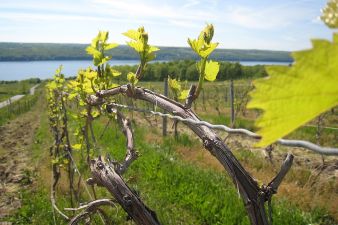
Vines above Seneca Lake in the Finger Lakes. Grapes grow best at a soil pH of 5.5–6.5. Photo: Plutor, CC BY 2.0
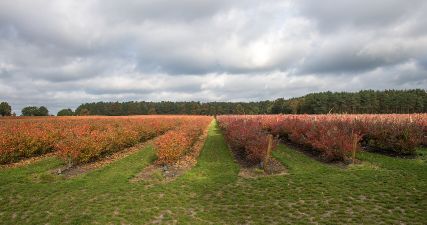
A commercial blueberry field. Blueberries need acidic soil, pH 4.5–5.0. Photo: Hannes Grobe, CC BY-SA 4.0
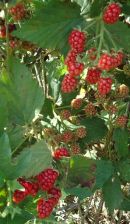
Raspberries take up less magnesium as soil pH drops. Photo: Tomwsulcer, CC0
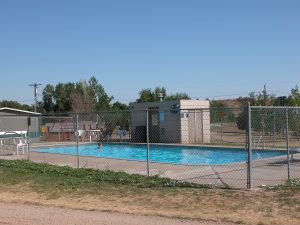
Pool water is kept near pH 7.4 so that hypochlorous acid can sanitize it. Photo: Ildar Sagdejev, CC BY-SA 4.0
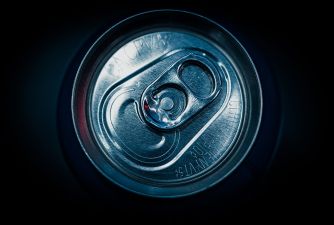
Acidic drinks need a plastic liner to keep them from corroding the aluminum. Photo: Tony Webster, CC BY 2.0
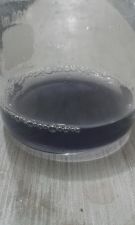
The end point of an iodine clock reaction. Photo: Daniel J. Lulu, CC BY-SA 4.0
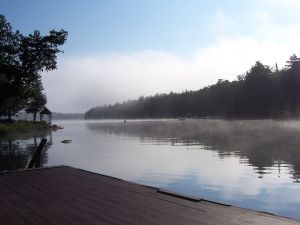
Big Moose Lake in the Adirondacks, one of the most studied acid-rain lakes in North America. Photo: James H. Dunning, CC BY-SA 2.5
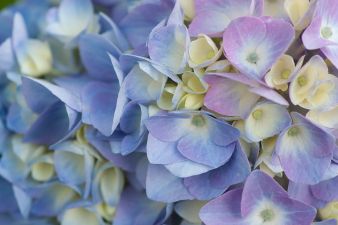
Bigleaf hydrangea blooms blue in acidic soil and pink in alkaline soil. Photo: Dwight Sipler, CC BY 2.0


The NYSED-specific disciplinary core idea for HS-PS1-11 (see NGSS Dimensions below) names the contexts in which acids and bases matter: "agricultural applications, environmental impacts (acid rain), animal and plant physiology" and the daily lives of humans and other organisms. Every phenomenon that a released Regents question has used to assess this standard is listed below, with a link to the question that uses it.
Agricultural applications: soil pH
- Grape and apple orchards. New York is the third-largest grape producer and second-largest apple producer in the United States, and soil pH is one of the factors that limits yield. Grapes grow best in soil with a pH of 5.5–6.5, while apples do best in well-drained soil at pH 6.0–7.0, and students compare the hydronium ion concentrations of the two optimal ranges. — The Fruit Industry in New York State (August 2026, Question 6)
- Testing a blueberry field. Blueberries need unusually acidic soil, with optimal growth between pH 4.5 and 5.0. A farmer's soil test comes back with a hydronium ion concentration of 1.0 × 10⁻⁸ M (pH 8), far too basic, and students choose which two acid-base indicators together could confirm whether the soil has reached the target range. — A Profitable Blueberry Field (Sample cluster, Question 1)
- Acidifying soil with elemental sulfur. Growers lower soil pH by working elemental sulfur into the field, where soil bacteria oxidize it to sulfuric acid: 2S + 3O2 + 6H2O → 4H3O+ + 2SO42−. Students connect a drop of 3 pH units to a thousandfold increase in hydronium ion concentration. — A Profitable Blueberry Field (Sample cluster, Question 2)
- Ammonium fertilizer as a gentler acidifier. Because sulfur can over-acidify soil, farmers may use ammonium sulfate instead: the ammonium ion donates a hydrogen ion to water (NH4+ + H2O ⇌ NH3 + H3O+) and is also oxidized by soil bacteria to nitrate and H+. Students identify the ammonium ion as the acid and water as the base and explain the pattern of behavior behind each label. — A Profitable Blueberry Field (Sample cluster, Question 3)
- Raspberries and magnesium uptake in the Finger Lakes. Plants absorb aqueous magnesium ions from the soil for photosynthesis, but absorption is cut in half when soil pH falls from 6.5 to 4.5. Raspberries grow best at pH 5.5–6.5, so soil in the northern Finger Lakes (pH above 7) is acidified with elemental sulfur, aluminum sulfate or manure, while limestone and dolomite raise the pH of soils that are too acidic. Students compare the hydronium ion concentration at pH 6.5 with that at pH 4.5. — Photosynthetic Pathways (June 2026, Question 40)
Daily life: pools and beverages
- Cloudy pool water. After a pool has been covered all winter, high phosphate levels feed algae, and calcium and magnesium ions combine with carbonate ions to form precipitates that cloud the water; a rise in pH above the optimal range makes precipitates form as well. Hypochlorous acid, HClO(aq), sanitizes the pool, and dilute hydrochloric acid is added to stabilize its concentration. Students decide which ion's concentration should be increased to reduce cloudiness. — Pool Water Chemistry (August 2026, Question 23)
- Testing pool water with indicators. A water-quality test on a pool sample reports a pH of 5.5 along with calcium hardness, free chlorine and phosphate levels. Given the color-change ranges of methyl orange, bromothymol blue, phenol red and bromocresol green, students predict the color each indicator turns in the sample. — Pool Water Chemistry (August 2026, Question 25)
- Acidic drinks in aluminum cans. Some canned beverages need a plastic lining to keep the acidic drink from corroding the aluminum. Given the pH of six beverages, from cola (2.3–2.9) and white grape juice (3.4) up to fortified water (9.0–9.5), students count how many would require the lining. — Chemistry of Beverages (June 2026, Question 9)
- Telling two sport drinks apart. One sport drink has a pH of 3.0–3.5 and another a pH of 8.8. Using the color-change ranges of bromocresol green, indigo carmine, phenol red and thymol blue, students pick the pair of indicators that would distinguish the two drinks. — Chemistry of Beverages (June 2026, Question 10)
Laboratory investigations
- The iodine clock reaction. In a clock reaction the end point announces itself with a sudden color change: here, molecular iodine formed from potassium iodate and sodium bisulfite turns a starch solution dark blue. In the first step, IO3− + 3HSO3− → I− + 3H+ + 3SO42−, the bisulfite ion gives up hydrogen ions, and students identify it as the acid because it is a hydrogen ion donor. — Clock Reaction (June 2026, Question 30)
Resources
Examples and discussion of resources for the learning, teaching, and assessment of HS-PS1-11.
 This section could be expanded upon. You can help out by adding to this section.
NGSS Dimensions
Performance expectation HS-PS1-11 was developed using the following elements from the NRC document A Framework for K-12 Science Education:
- Planning and Carrying Out Investigations
- Plan and conduct an investigation individually and collaboratively to produce data to serve as the basis for evidence, and in the design: decide on types, how much, and accuracy of data needed to produce reliable measurements and consider limitations on the precision of the data (e.g., number of trials, cost, risk, time), and refine the design accordingly.
- Select appropriate tools to collect, record, analyze, and evaluate data.
- PS1.B: Chemical Reactions
- (NYSED) Acids and bases play an important role in the daily lives of humans and other organisms (e.g. agricultural applications, environmental impacts (acid rain), animal and plant physiology).
- Patterns
- Different patterns may be observed at each of the scales at which a system is studied and can provide evidence for causality in explanations of phenomena.