NYS Chemistry Reference Tables · 2025 Edition
The Reference Tables for Physical Science: Chemistry (2025 Edition) are the reference tables students use throughout the Chemistry course and during the Regents Examination in Physical Science: Chemistry, which was first given in June 2026. They replace the Chemistry Reference Tables (2011 Edition) used with the previous Physical Setting/Chemistry Regents exam, and they are much shorter: eight tables on four pages, where the 2011 edition had Tables A to T and a more detailed periodic table.
Every table below links to a page with the table itself, what it shows, and the released Regents questions that depend on it. Each caption lists the performance expectation the table primarily supports; the two equation tables are listed row by row, since each row belongs to a different standard.
HS. Structure and Properties of Matter


HS. Waves and Electromagnetic Radiation

Equations, relationships, units and prefixes
These four tables are used across the course rather than with one topic.
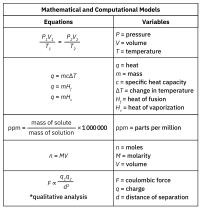
Mathematical and Computational Models
combined gas law HS-PS1-9 · heat HS-PS3-1 · ppm and n = MV HS-PS1-10 · Coulombic force HS-PS3-5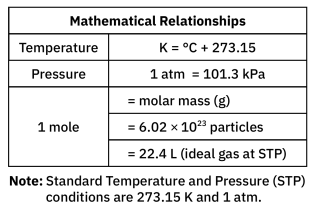
Mathematical Relationships
temperature, pressure and STP HS-PS1-9 · mole HS-PS1-7


Which tables go with which standard
The engineering design standards (HS-ETS1-1 to HS-ETS1-4) and HS-LS1-5 use no reference table.
How the tables are used on the exam
No released question so far names a reference table. The June 2026 and August 2026 exams and the three NYSED sample clusters never say "according to the Periodic Table" or "using the Reference Tables", as the old exam did; a question simply depends on a table, whether for a molar mass, the kelvin conversion or the symbol of an alpha particle. Much of the information that used to be on the reference tables is now supplied in the question cluster when it is needed: specific heat capacities, heats of solution, acid–base indicators, pH values, vapor pressures and boiling points, decay modes, ionization energies and atomic radii, and often molar masses too.
On this wiki, a question that cannot be answered without a table carries a chip next to its standard on the cluster page, for example HS-PS1-9 Combined gas law K = °C + 273.15, and each table page lists those questions.
About the 2025 Edition
Compared with the 2011 edition, the 2025 edition drops the physical constants for water (Table B), the solubility guidelines and solubility curves (Tables F and G), the vapor pressure curves (Table H), heats of reaction (Table I), the activity series (Table J), the acid, base and indicator tables (Tables K, L and M), the radioisotope table (Table N), the organic chemistry tables (Tables P, Q and R) and the properties of selected elements (Table S), and it removes electron configurations and oxidation states from the periodic table. The current official PDF is published on NYSED's state assessment site, on the page titled "Reference Tables for Physical Science: Chemistry".